NEOSWARM·LOCAL MULTI-AGENT ORCHESTRATOR
Your agents should not need a cloud account to think.
NeoSwarm is a local-first multi-agent system. A team-lead agent breaks a mission into sub-tasks, delegates them to parallel workers, and merges the results. It runs on Ollama by default. Cloud models are opt-in, not assumed.
Role
Sole author
Language
Python, TypeScript, Rust
Runtime
Native Python loop + FastAPI
Providers
Ollama, OpenAI, Anthropic, Gemini
Architecture
How the system fits together
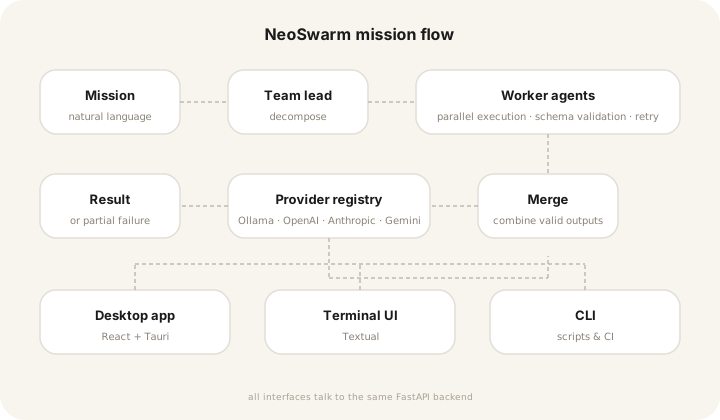
Team-lead agent → task decomposition → parallel worker agents → provider registry (Ollama / cloud)
The problem
The demo is not the runtime
Most agent demos are a single prompt to a cloud model, followed by a JSON parse and a screenshot. The real work starts when the network drops, the model returns a different shape, or the task is too large for one context window.
A useful runtime has to plan, delegate, recover, and run where the user works. For a lot of people that means a laptop with no API key budget.
Competitive gap
What existing agent tools get wrong
Single-prompt tools look magical in a tweet but fall apart on multi-step tasks. Frameworks like LangChain help wiring, but they still assume a cloud API key and a single model. None of them treat “run offline” as a first-class constraint.
NeoSwarm is built around the constraint: plan, delegate, and recover locally. Cloud is an opt-in provider, not an assumption.
User context
Who this is for
NeoSwarm is for developers and power users who want automation they can run on their own machine without renting a cloud agent. They care about cost, privacy, and being able to debug what happened.
What a safe run looks like
The shape of a mission
A mission enters as natural language: "Research the best local LLMs for a MacBook Air, then write a one-page comparison." The team-lead turns that into sub-tasks, each with an output schema and a retry budget. Workers run in parallel where possible. A merger combines outputs that pass validation.
If a worker fails or returns malformed output, it is retried with the schema error attached. If it still fails, the mission surfaces the partial result instead of pretending it succeeded.
Abstraction
The provider registry buys portability
Every provider implements the same three methods: generate, stream, and embed. The registry loads the configured default and falls back if a local model is missing. The rest of the system never imports an SDK directly.
class ProviderRegistry:
    def __init__(self, config: ProviderConfig):
        self._provider = self._load(config.default)

    def generate(self, prompt: str, **kwargs) -> str:
        return self._provider.generate(prompt, **kwargs)

    def stream(self, prompt: str, **kwargs):
        yield from self._provider.stream(prompt, **kwargs)

    def embed(self, text: str) -> list[float]:
        return self._provider.embed(text)

    # A model swap is a config change, not a refactor.
Surfaces
Three interfaces for the same runtime
The same Python agent loop powers three frontends. The React/Tauri desktop app is for visual workflows. The Textual terminal UI is for keyboard-driven use. The Python CLI is for scripts and CI.
They all talk to the same FastAPI backend, so a run started in the CLI can be inspected later in the desktop app.
Measured on a MacBook Air M2
What local-first costs and buys
Running Llama 3.2 locally is slower per token than GPT-4o-mini, but the first request has no cold start and there is no bill at the end of the month. The numbers below are from a small benchmark of decomposition + three parallel workers.
~2.4s
First token latency
LLAMA 3.2 3B, QUANTIZED
₹0
Token cost
OLLAMA LOCAL
3
Interfaces
DESKTOP · TERMINAL · CLI
Source · local benchmark, 10 sample missions
Lessons
What building it taught me
The hardest part of multi-agent systems is not parallelism — it is convergence. Four workers producing four answers is easy; four answers that compose into one coherent result is hard. It needs explicit output schemas, retry boundaries, and a team-lead that knows how to say “this does not fit.”
Running locally also forces discipline. You cannot paper over latency with a bigger API budget. The loop has to be small, cacheable, and interruptible.
A multi-agent system is only as good as its refusal to merge garbage.
Still open
Where it is still rough
Convergence is heuristic
The merge step uses structured output and overlap checks, but it cannot guarantee semantic consistency across workers. Some missions need a human merge.
Local models are shallow
Llama 3.2 3B is fast but struggles with complex decomposition. The registry makes swapping easy, but the default experience depends on hardware.
No persistent memory yet
Each mission starts fresh. Long-running context and learned aliases are planned but not implemented.
In short
What NeoSwarm came down to
01
Run offline by default
Local execution is not a feature; it is the constraint that forces the rest of the design to be efficient.
02
Model is a provider
The agent loop should not care whether the model is Ollama, OpenAI, or Anthropic.
03
Merge is the bottleneck
Parallel workers are cheap. Making their outputs compose is the expensive part.