VANTAGE·A 3D FORMULA 1 REPLAY
A replay should be a place, not a recording.
Vantage replays the 2024 Japanese Grand Prix as a 3D miniature: the whole Suzuka field on a tabletop, seventeen cars moving, and three cameras — drawn with Expo GL and Three.js, not played back from a video and not a WebView.
Role
Sole author
Stack
React Native · Expo GL · Three.js
Data
OpenF1 recorded sessions
Verified
Android release APK, on a Note 20



Screens
01 / 06
Architecture
How the system fits together
OpenF1 recordings → replay engine (one clock) → Expo GL scene (licensed circuit + 17 car projections) → three cameras; timing and telemetry read the same clock
The problem
A replay is a recording
Almost every replay app plays a video. A video is a picture of a broadcast: the camera is where the director put it, the field is a photograph, and nothing on screen can be checked against the timing. Scrub back and the picture changes; the race does not.
The data behind a race is not like that. Position, lap, gap and telemetry for every car are recorded, and they are all on one clock. So the question was whether the same data could be drawn as a place — a circuit you can look at, with the cars on it moving at the times they actually moved, and the numbers beside them.
The drawing is the easy half. The hard half is what the app is allowed to show when the data is thin. A 3D view is persuasive, and a persuasive view that guesses is worse than a table that admits a gap.
Competitive gap
What replay apps get wrong
Three habits run through the category, and each one gives up the same thing: the ability to check a claim.
Vantage is deliberately narrow. It replays one recorded race, on one circuit, and it is honest about the limits of what that recording contains.
The views
Three cameras, one clock
The three cameras answer three different questions. **Overview** shows the whole field, so the shape of the race is visible: where the pack is, where the gaps opened. **Follow** stays with one car and can be orbited and pinched; the selected car keeps its label and its ground ring. **Battle** frames two cars together, and a group-count badge discloses when projected cars overlap rather than inventing lanes for them.
All three read the same clock. The scrubber is the replay; the cameras are views onto it.
The data
Recorded, with the gaps left visible
The app replays documented OpenF1 recordings from the 2024 Japanese Grand Prix — position, lap, timing and telemetry for a 120-second excerpt.
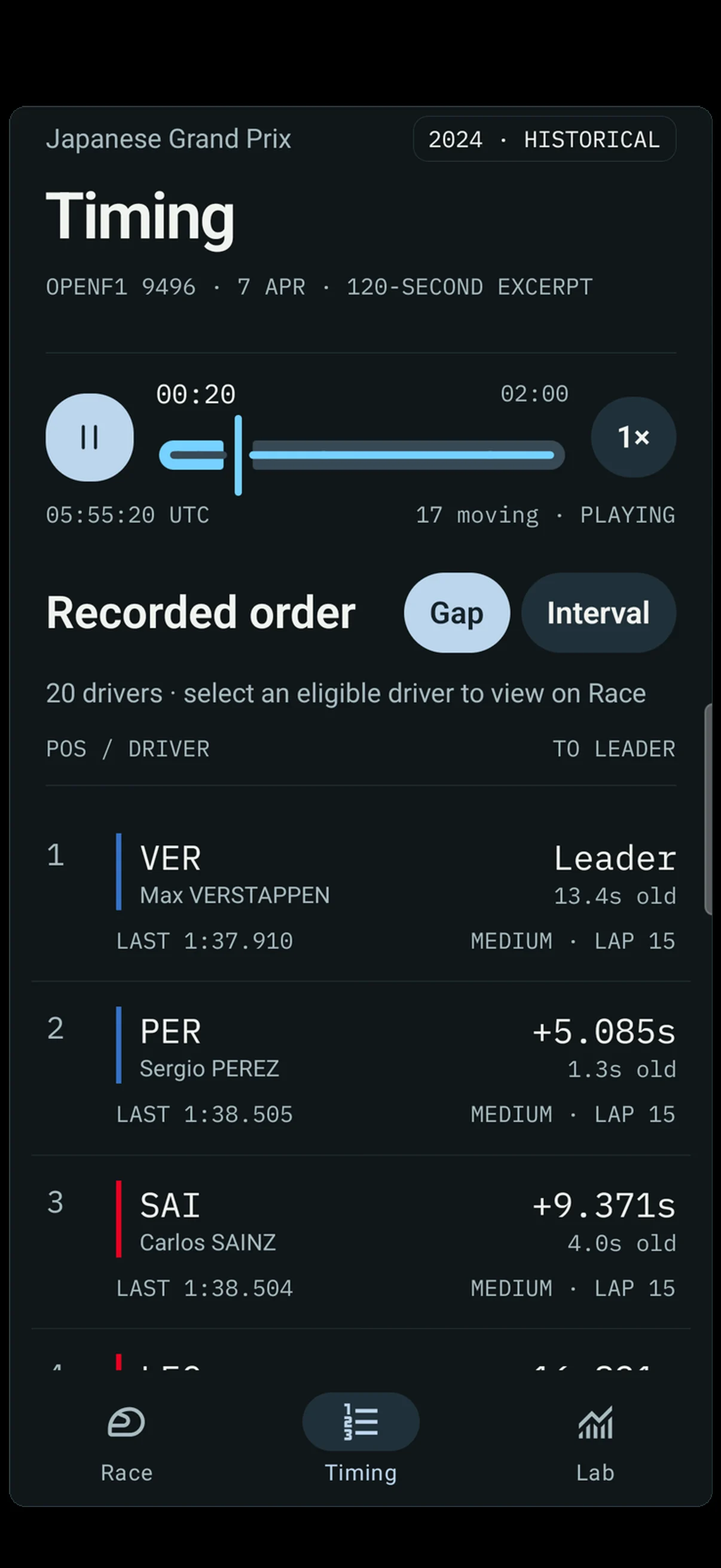
The timing screen shows the recorded order with a gap or an interval, the last lap, and the age of the source. Sparse events are not inferred from the miniature: a timing screen that quietly invents a missing event is worse than one that admits the data is thin.
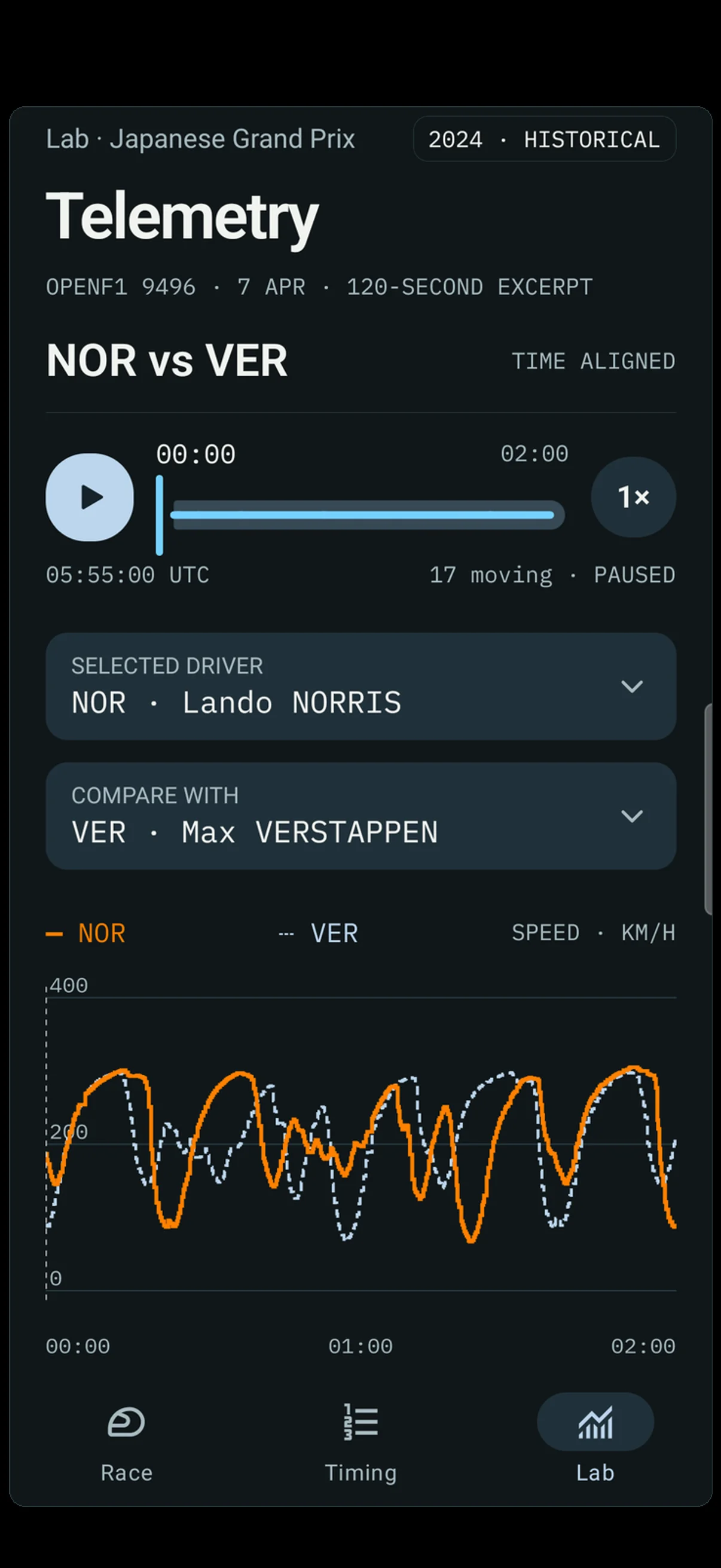
The lab screen puts the telemetry on the same clock as the cars — speed traces for two drivers, time-aligned, with speed, throttle, brake, gear and RPM read out at the shared cursor. The miniature and the numbers are the same moment, so a claim can be checked.
Returning from the background leaves the replay paused at the last cursor rather than jumping forward, and timing and telemetry stay available while it is paused.
The renderer
Drawn, not played
The native client draws the circuit, the field and the cameras with Expo GL and Three.js. There is no WebView and no video playback: the circuit is a miniature on an olive tabletop, built from editable Blender sources, with the cars as moving projections.
The renderer does 2× supersampling in the native target — an sRGB target, with a linear path and a direct fallback. On the test handset that cut the hard-step fraction from 0.640 to 0.298, so the visible stair-stepping on the track edges roughly halved. It also roughly doubles the measured GPU frame cost, and a hundred seconds of playback is 3.99% janky against 1.72% without it, so **60 fps is not claimed**. A 1.5× experiment traded sharpness for GPU headroom without a consistent jank win, and no adaptive mode is shipped.
Results
What is verified, and what is not
Everything claimed here was measured on a physical Samsung Note 20 5G running a release APK — not a simulator and not a mockup. Startup, camera-change and moving-field pixel gates pass as real GL-region comparisons rather than UI-only checks. The pacing figures, the overview framing fix and the supersampling are recorded in the repository's own validation notes, and `npm run check` runs the typechecker, the linter and 39 pure tests.
The honest part: the gaps are specific, and the repository lists them.
39
Pure tests
TYPECHECK · LINT · TESTS
0.298
Hard-step fraction
DOWN FROM 0.640
3.99%
Janky frames
OVER 100 SECONDS
Source · Samsung Note 20 5G, Android 13, release APK, 2× supersampling
Lessons
The pixels are the easy half
Drawing seventeen cars on a circuit in a GL context turned out to be the straightforward part. The part that took the work was deciding what the app was allowed to show when the data was thin.
A car crossing the line is a fact. A car in second place is a judgement the data has to support. So the group-count badge discloses overlapping projections instead of drawing lanes that were never there, the timing screen shows the age of its source instead of inferring sparse events from the miniature, and the miniature is never allowed to be the source of a number.
The second lesson was that a measurement you do not publish is a measurement you did not make. The render notes carry the hard-step fraction, the jank percentage, the changed-pixel counts from the camera sweep, and the 1.5× experiment that did not help — including the costs that were accepted rather than hidden.
A 3D view is persuasive. A number has to be true.
Still open
What is not established yet
No physical iPhone has run it
Simulator moving-replay presentation is a known Expo GL limitation. The iOS build exists, but no physical iPhone has run the app, so iOS device behaviour is not established.
60 fps is not claimed
2× supersampling roughly doubles the measured GPU frame cost. Sustained performance and thermals beyond the hundred-second aggregate run are not established, and no adaptive mode is shipped.
One handset, one race
The evidence is a single Note 20 and a single 120-second excerpt. A GPU-trace-level profile, p99 hitches, intermittent blackouts, ghosting, and any device beyond the one test handset are all open.
No store submission
The local APK is debug-key signed, not a Play Store artifact. There is no live-data integration, and commercial rights for a live feed are not cleared.
The circuit is illustrative
The plan geometry is MIT-licensed and the licence is preserved, but elevation, structures and scale are not surveyed. The replay uses documented OpenF1 recordings; it is not a live feed.
In short
What Vantage came down to
01
Drawn, not played
The replay is a live rendering of recorded positions, not a video. That is the whole difference between watching a race and being able to check it.
02
The view cannot invent
Where the data is thin the view says so: badges that count overlaps, timing that shows its source age, and never a lane the data does not have.
03
Publish the measurements
The jank, the hard steps and the failed experiment are in the repository. A claim about smoothness whose cost you cannot see is a claim you have not checked.