TRACKSHIFT·F1 RACE ENGINEER
The race engineer should explain why, not just what.
Trackshift is an interactive Formula 1 telemetry replay with a hierarchical AI race engineer. It turns observable signals — speed, throttle, braking, gaps, tyres, DRS — into auditable tactical recommendations and isolated counterfactual “what if?” simulations. It placed 2nd nationally at TrackShift 2026.
Role
Team lead / AI engineer
Language
Python
Data
FastF1 telemetry
Competition
TrackShift 2026, 2nd place
Architecture
How the system fits together
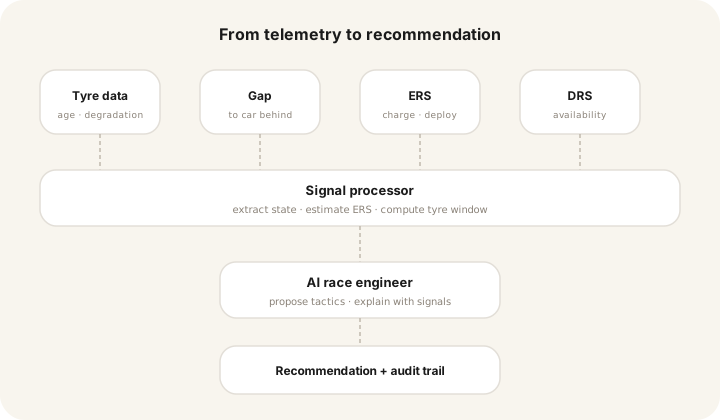
FastF1 telemetry → signal + ERS estimation → AI race engineer → replay UI
The problem
Telemetry is abundant. Insight is scarce.
A single F1 lap produces hundreds of signals. The hard part is not collecting them; it is deciding which ones matter for a specific decision and explaining that decision to a human who has seconds to act.
Most telemetry dashboards show curves. They do not show reasoning.
Competitive gap
What existing race tools get wrong
Timing apps and telemetry dashboards show what happened, but they do not explain why a strategist made a call or let you test an alternative. Broadcast commentary is narrative, not reproducible.
Trackshift closes the gap by tying every recommendation to the signals that produced it and letting the user rerun history with one variable changed.
The split
A race engineer with an audit trail
Trackshift uses a two-level agent. A lower-level signal processor extracts tyre degradation, energy state, and gap trends from FastF1 data. A higher-level strategist reads those summaries and proposes tactics: pit now, push for an undercut, defend position.
Every recommendation is tied back to the observable signals that produced it. You can click a recommendation and see the exact telemetry window it came from.
Counterfactuals
What if we had pitted one lap earlier?
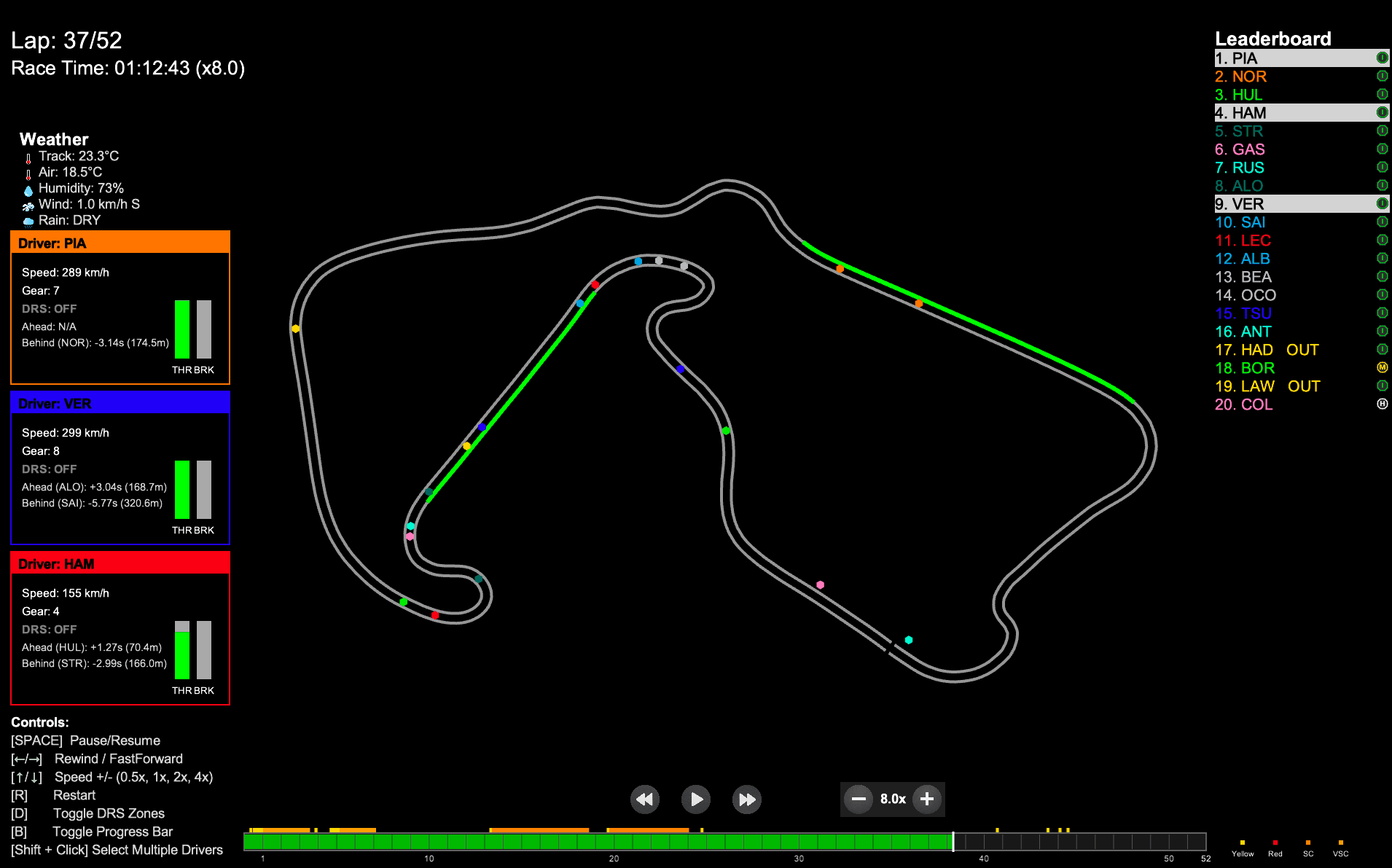
The replay UI runs isolated counterfactuals: freeze the race at any lap, change one decision, and simulate the outcome against the historical baseline. The simulation is intentionally simple — it does not predict the future; it shows sensitivity.
That constraint keeps the tool honest. It explains leverage, not destiny.
TrackShift 2026
Competition results
TrackShift 2026 was a national F1 innovation challenge hosted by Mphasis and TGR Haas F1 Team.
2nd
National place
AMONG 180+ PARTICIPANTS
180+
Participants
NATIONAL ROUND
7
Telemetry signals
SPEED · THROTTLE · BRAKE · GAP · TYRES · DRS · ERS
Lessons
What building it taught me
The most convincing AI explanations are the ones that point at data. A recommendation without a trace is just an opinion with confidence.
Counterfactuals are more useful when they are obviously wrong. If your simulation claims to predict the exact race outcome, nobody trusts it. If it says “this decision was worth about four tenths,” people listen.
A race engineer who cannot show the telemetry behind a call is just another opinion.
Still open
Where it is still rough
Historical data only
The replay uses FastF1 historical data. Real-time telemetry would require a commercial F1 data license and a very different latency budget.
Simplified physics
The counterfactual model does not simulate tyre thermal cycles, fuel load, or traffic. It is a sensitivity tool, not a race simulator.
Strategist is only as good as the signals
If FastF1 data has gaps or the feature extraction misses a state change, the recommendation will be wrong.
In short
What Trackshift came down to
01
Explain with data
Every recommendation must point at the signals that produced it.
02
Separate signal from strategy
Let code extract state; let the model reason about tactics.
03
Show leverage, not destiny
Counterfactuals should reveal sensitivity, not claim exact predictions.